- Highly fun with great replayability
- Easy to learn with deep gameplay
- Strong recommendation for roguelike fans
- Insufficient content volume in game
- Weak story mode lacks endless mode
- Frequent crashes and severe lag
Emotions
Archetypes
Hardware
What players like:
Common complaints:
Gameplay feedback:
Performance notes:
Recommendations:
Other player notes:
Similar games
Blend with other games




Review evidence
Why players say this
Review evidence
Why players say this
Steam review verdict
A fun and deep roguelike with great replayability, but suffers from limited content, a weak story mode, and frequent crashes and lag.
What players like
Game is highly fun: Many reviews describe the game as fun, addictive, and entertaining, with a good balance of challenge and enjoyment. The overall gameplay experience is positively received across the board.
Excellent replayability and addictiveness: Players highlight the game's high replay value and addictive nature, often finding it hard to put down. The variety and randomness of runs keep the experience fresh.
Easy to learn and play: The game is accessible and easy to pick up, with a low difficulty threshold that makes it simple to understand. This lowers barriers for new players.
Great gameplay depth and content: The game offers substantial depth and a large amount of content, with complex combos and interactions. Many players feel it stands out in its genre for variety and depth.
Good value for price: The game is considered well worth its asking price, especially when on sale, with content that offers high cost-performance value. Many reviewers strongly recommend the purchase.
Common complaints
Insufficient content volume: Players consistently report that the game lacks overall content and is too short, which reduces engagement and makes it feel boring. Merges several clusters mentioning limited content and the need for more content.
Weak story mode and lack of endless mode: Players find the story mode too short and lacking continuation, with no endless mode to sustain replayability and motivation. Some also rate the story quality as poor.
Poor art and graphics quality: Art style and graphics were described as meh, low quality, ugly, or grotesque, indicating a visual presentation issue. Aesthetics are negatively received by players.
Crashing issues after update: The game crashes repeatedly during play and may fail to launch or crash immediately after an update, interrupting runs and frustrating players.
Repetitive and shallow late game: The late game becomes repetitive and lacks depth, leading to insufficient late-game levels and a sense of sameness after multiple completions.
Gameplay and performance
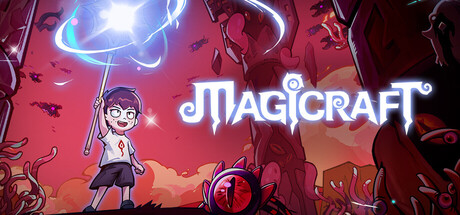
Roguelike structure with runs: The game is described as a roguelike or roguelite, featuring procedurally generated runs, permadeath, and high replayability. Comparisons to Noita and The Binding of Isaac are common.
Wand building and crafting: A key feature is the ability to build and customize wands, placing spells and modifiers to create powerful synergies. This system is often compared to Noita's wand mechanics.
Multiple difficulty levels: The game offers various difficulty settings, including Hard, Nightmare, and hardcore modes, with progression through increasingly challenging tiers. This caters to different player skill levels.
Build and progression systems: Players can create diverse builds and experience meta progression with upgrades. The game offers many customization options, focusing on build variety rather than just difficulty.
Bullet hell combat elements: Combat includes bullet hell mechanics, adding intensity and requiring precise dodging, which enhances the game's challenge.
Frequent crashes and freezes: Players report widespread crashes, including on startup, during boss fights, and when many effects appear. Some also experience freezes and hang-ups, indicating stability issues that persist across various scenarios.
Severe lag on lower-end laptops: The game can become nearly unplayable on some laptops, with performance degrading to slideshow quality in later levels. Some players report it runs fine on minimal specs, but this is inconsistent with others' experiences.
Performance varies across hardware: While some players with integrated graphics or older laptops report smooth play, others experience stutters and low FPS even on high-end CPUs. This suggests inconsistent optimization across different system configurations.
Performance drops with spell effects: Many reviews highlight lag and frame rate drops caused by copy-type spells and numerous particle effects. This is a common complaint even on good hardware, suggesting the game's rendering or effect handling strains the system.
Extreme builds cause crashes and lag: Overpowered combinations and exponential spell scaling can overload the CPU, leading to severe lag and crashes. This is a recurring theme for high-level play, indicating the game's simulation depth can push even strong hardware to its limits.
Recommendations
Overall strong recommendation: Players overwhelmingly recommend the game, often using phrases like 'do not sleep on this game' and 'well worth the asking price.' Reviewers express strong support and find it highly enjoyable.
Great for roguelike fans: The game is frequently recommended to fans of roguelikes and roguelites, described as a must-play and must-have for the genre. It is also praised for its high replayability and build customization.
Comparable to popular titles: Players draw comparisons to beloved games like Binding of Isaac, Noita, and Vampire Survivors, suggesting that fans of these titles will likely enjoy this game. This helps position the game within a familiar context for potential buyers.
Spell combination experimentation praised: Reviewers highlight the variety driven by tons of spell combinations and encourage experimentation. The spell-mixing and hardcore combat feel are seen as key draws.
Good value for price: Reviewers repeatedly state the game is worth every penny and worth the asking price, even more so during sales. It is seen as a beneficial investment.
Buying context
Community fair range: $10.00 - $15.00.
Game completion: 52.0h.
Story completion: 28.0h.
Session length: 2.0h.
Magicraft is immediately addictive but becomes repetitive and less fun after the first few hours or after completing the game, with early friction from grindy meta-progression and a steep learning curve.
Friction: grindy early meta-progression; steep learning curve; annoying start of each round; long run duration.
Unlock drivers: unlocking new spells and relics; learning spell crafting mechanics; beating the first major boss.
Player profiles
Build Theorycrafter: Actively experiments with spell combinations, seeks to create game-breaking builds, often exploits mechanics. Motivation: Discovering and exploiting broken spell synergies. Stance: buy.
Casual Noita Enthusiast: Takes a relaxed approach to runs, enjoys building creative wands, appreciates moderate difficulty. Motivation: Enjoying accessible spellcrafting and run structure without Noita's punishing depth. Stance: buy.
Disappointed Veteran: Completes the game but criticizes its shallow depth, bullet sponge enemies, and meta progression flaws. Motivation: Seeking deep, polished roguelite design but finding this game lacking in content and balance. Stance: sale.
Platform notes
The game generally performs well on most hardware, but some users report freezing on systems with 8-11GB VRAM and severe fps drops on high-end builds during particle-heavy moments.
Windows <8GB VRAM: positive. Users report clear visuals and no performance issues on this hardware.
Windows 12-15GB VRAM: positive. Performance is generally good, but heavy particle effects can cause severe fps drops (down to 2 FPS).
Windows 8-11GB VRAM: mixed. Conflicting reports: some users experience constant freezing when casting spells, while others find the game enjoyable without performance complaints.
Steam Deck: The game exhibits severe stability issues including frequent crashes, black screens, and failure to launch after updates, especially under high effect loads. Performance suffers from a CPU single-core bottleneck causing frame drops even on decent hardware. Proton compatibility is inconsistent, with some users reporting smooth gameplay while others encounter crashes. Overall, the experience is broken for a significant subset of players.
Extra review signals
Monetization: The game features only traditional paid DLC (cosmetic skin) with no microtransactions, gacha, or pay-to-win elements. The community overwhelmingly supports paid DLC as a way to support the developer, indicating fair monetization.
External guides: Principal feedback indicates that unclear skill descriptions and hidden complexity in special mechanics compel players to seek external strategy guides, though many other reviews praise the game for being playable without a wiki. The dependency is moderate and focused on instructional data.
Other review notes
Frequently compared to Noita: Many reviews compare the game to Noita, noting similarities in spell crafting and explosive build combinations. However, they often mention that this game is more accessible and less punishing than Noita.
Similar to Binding of Isaac: Several reviews compare the game to The Binding of Isaac, citing similar design influences and roguelike elements. Some mention it blends features from both Isaac and Noita.
Free DLC releases: Reviews highlight that the developer has released free DLC and updates, showing ongoing support for the game. This is positively received by the community.
Wishes for more content: Some reviewers wish for additional content, such as more maps ands spells, indicating a desire for expansion beyond the current offerings.
Content depth praised: The game is noted for having substantial content, including many unlockables and achievements. Some reviews mention it offers enough to warrant the price and time invested.