- Promising and unique concept
- Unique medic perspective
- Solid core gameplay
- Deep medical mechanics
- Performance issues persist
- AI voice acting issues
Emotions
Archetypes
Hardware
What players like:
Common complaints:
Gameplay feedback:
Performance notes:
Recommendations:
Other player notes:
- -
No data available
Similar games
Blend with other games



Review evidence
Why players say this
Review evidence
Why players say this
Steam review verdict
A promising unique medic perspective with solid gameplay and deep mechanics, but marred by performance issues and problematic AI voice acting.
What players like
Promising and unique concept: The core idea of playing as a combat medic is widely seen as innovative and full of potential. Many reviews note the game's strong foundation and hope for future improvements.
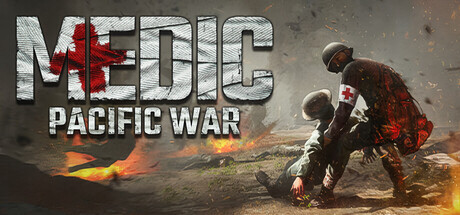
Unique medic perspective: The game offers a rare and refreshing focus on the role of a combat medic in WWII, emphasizing saving lives over combat. This unique angle is praised for its originality and emotional depth.
Solid core gameplay: The gameplay loop, including resource management, healing mechanics, and enemy mitigation, is considered well thought out and in a solid state. It provides a fun and unique experience that stands out.
Intense and immersive gameplay: Players describe the experience as gripping, with constant tension from managing limited supplies and making difficult triage decisions. The atmosphere and pressure create a compelling, stressful gameplay loop.
Historical accuracy and detail: The game's attention to historical detail in uniforms, equipment, medical procedures, and settings is frequently commended. It adds authenticity and immersion, particularly in portraying WWII battlefield medicine.
Common complaints
AI voice acting issues: Players widely report that voice acting sounds AI-generated, with poor grammar, lack of emotion, and disinterested delivery. This suggests the use of placeholder or low-quality AI voiceovers.
Performance issues persist: Multiple players experience low FPS, stuttering, and high memory usage even on high-end rigs. The game struggles to maintain smooth performance, with reports of drops from 120 FPS to 15 FPS.
Sound design lacks impact: Explosions, gunshots, and bombs are often barely audible or lack intensity. Sound mixing is poor, with voice lines too loud over effects, and generic audio design overall.
Graphics need improvement: Graphics are cited as only okay or not captivating, with some comparing them to outdated PS3/360 era visuals. The game lacks modern graphical polish and appeal.
Rough edges and polish: The game is described as still rough around the edges, needing significant work on polish, animations, and overall quality. Multiple clusters point to unfinished state.
Gameplay and performance
Medic-focused WWII game: Players consistently describe a WWII game where the core role is a non-combat medic, focusing on treating and carrying wounded soldiers instead of fighting. This unique perspective emphasizes healing over killing.
Multiple treatment procedures: The game features detailed medical mechanics where players must treat wounds, stop bleeding, apply bandages or tourniquets, and stabilize patients before carrying them to aid stations.
Minigame-based healing system: Several clusters describe minigames for wound treatment, often QTE-based, with risk-reward mechanics. These involve timed actions like bandage wrapping or tourniquet application, adding interactive depth to the healing process.
Triage and decision-making: Players highlight the pressure of choosing which wounded to treat first with limited supplies, making quick moral decisions under fire. This includes managing resources and prioritizing patients in a tense environment.
Carrying and dragging wounded: Players mention dragging or carrying wounded soldiers behind cover or to aid stations, often with animation locks. This physical evacuation mechanic is central to the gameplay loop.
Severe FPS drops across hardware: Multiple clusters report low and unstable frame rates, often dropping below 30 FPS even on low settings. This suggests a critical performance bottleneck affecting a wide range of GPUs and resolutions.
Stuttering and freezing common: Several clusters mention stuttering, freezing, and lag spikes, especially on lower settings or during specific scenes like the prologue and second level. This indicates inconsistent performance beyond just low FPS.
General optimization complaint: Many clusters simply say 'optimization needed' or 'poorly optimized' without specific details, indicating a broad consensus that the game is not ready for release.
High-end GPUs still struggle: Clusters show even RTX 4060 and 5060 Ti cards hit very low FPS (5–10) on minimum settings. This points to a fundamental optimization issue that overpowers modern hardware.
Low settings still required: Many users say the game is only playable on the absolute lowest settings, and some still experience performance issues there. This limits graphical enjoyment for most players.
Recommendations
Performance and quality issues: Multiple reviews cite poor performance, bugs, and general quality concerns as reasons not to recommend the game in its current state. Clusters 1, 4, 6, and 40 all explicitly state the game is not recommended due to these issues.
Positive for medic role: Several reviews strongly recommend the game for players who enjoy the medic or healing role, highlighting its unique appeal to fans of that gameplay. Clusters 2, 41, and 43 specifically call out the medic experience as a reason to buy.
Wait for fixes and patches: Many users advise waiting for updates, optimization, or bug fixes before purchasing, suggesting the game needs more development time. Clusters 3, 17, and 34 all recommend holding off until issues are resolved.
Early access understanding needed: Some reviews highlight that the game is only suitable for those who understand and accept the nature of early access, with bugs and incomplete content. Clusters 5 and 26 recommend it specifically for early access supporters.
Mixed price value opinions: There is disagreement on whether the game is worth its current price, with some saying it is not worth over $10, while others find it a good budget buy. Clusters 11, 28, and 29 mention the game is not worth certain price points.
Buying context
Community fair range: $3.00 - $5.00.
Story completion: 2.0h.
Session length: 1.0h.
The game's fun centers on the Lifeline roguelite mode, which offers addictive progression and perks, but the initial QTE and scripted elements can become a barrier.
Friction: repetitive QTE loop; poor sound design; lack of controller support; repetitive dialogue.
Unlock drivers: Lifeline mode's roguelite progression; changing environments; permanent perks.
Player profiles
Early Access Patron: Tolerate bugs, focus on potential, may play casually. Motivation: Empower the developer and see the vision through. Stance: buy.
Humanitarian Narrative Seeker: Focus on narrative, engage with story, overlook technical flaws. Motivation: Experience a fresh take on heroism in war. Stance: sale.
Polished-Product Demander: Wait for improvements, scrutinize details, avoid early access. Motivation: Seeking a complete, polished experience. Stance: no buy.
Platform notes
Performance is generally poor on lower VRAM hardware, with mixed results in the mid-range, and good on high-end.
Windows <8GB VRAM: negative. Most users report poor optimization, low frame rates (often below 30-50 FPS on lowest settings), frequent crashes, and stuttering, even when playable.
Windows 12-15GB VRAM: mixed. One user reports no performance issues, while another reports a launch failure on Steam Deck due to missing Microsoft C++ dependencies.
Windows 8-11GB VRAM: positive. Users report playable but suboptimal performance, with stuttering in animations, low FPS without frame generation (e.g., 21 FPS), and reliance on upscaling to reach 60 FPS.
Steam Deck: Multiple reviews highlight critical issues: the game fails to launch on Steam Deck due to missing Microsoft C++ runtime, suffers from poor performance and optimization, lacks proper controller support, and exhibits shader-related graphical glitches. These combined barriers place the experience in the 'Broken' category.
Linux and Proton: Based on a single user report, the game has a launch blocker on Linux (Steam Deck) because it requires a Microsoft C++ runtime not bundled in the default Proton environment. No counter-evidence of successful Linux runs is present in the provided dataset. The issue may be resolved by installing the missing runtime, but the review frames it as a disappointment rather than a solvable tweak.