- Emergent storytelling sparks creative gameplay
- Highly addictive and widely praised
- Exceptional replayability and multiple approaches
- Inconsistent difficulty and balance issues
- Repetitive with lacking variety
- Minimal or absent story
Emotions
Archetypes
What players like:
Common complaints:
Gameplay feedback:
Performance notes:
Recommendations:
Other player notes:
Similar games
Blend with other games





Review evidence
Why players say this
Review evidence
Why players say this
Steam review verdict
Emergent storytelling and multiple approaches make it addictive and highly replayable, though inconsistent balance, repetition, and a thin story can wear thin.
What players like
Emergent storytelling and creativity: The game excels at generating emergent, story-like experiences, with randomly generated characters and missions leading to unique and often hilarious situations. It is praised as a compelling story-maker.
Highly praised and addictive: Reviewers overwhelmingly describe the game as amazing, fun, and addictive, with many calling it incredible or well-made. This broad enthusiasm is a dominant theme across clusters.
Engaging gameplay loop: The core gameplay loop is consistently highlighted as satisfying, smooth, and addictive, keeping players engaged without becoming boring. This is a key strength praised across multiple clusters.
Exceptional replayability: Players emphasize the game's immense replay value, with near-endless variety and constant surprises. Replayability is a major factor in the game's appeal.
Multiple playstyles and approaches: Reviewers appreciate the variety of playstyles and the numerous ways to approach each scenario, including outside-the-box solutions and creative thinking. This flexibility adds depth and replayability.
Common complaints
Inconsistent difficulty and balance: Difficulty is described as uneven, ranging from trivially easy to nearly impossible based on RNG, with high-level challenges feeling tedious rather than meaningfully harder. This inconsistency frustrates players.
Repetitive and lacking variety: Many players find the core gameplay loop becomes repetitive over time, with limited mission and content variety. This is one of the most frequently mentioned issues across multiple clusters.
Minimal or absent story: Reviewers consistently criticize the lack of a substantial narrative, with many stating there is essentially no story or that it is very thin. This significantly reduces engagement for players expecting a narrative-driven experience.
Poor tutorial and unclear systems: The tutorial and explanations of game systems are often cited as inadequate, leaving players confused about mechanics such as enemy shields, space travel, and menu controls. This contributes to a steep and frustrating learning curve.
Item and loot variety lacking: Players note a lack of diversity in weapons, tools, and loot, with many unlocks being mere improvements on base items. This leads to repetitive gameplay and a dominant strategy emerging quickly.
Gameplay and performance
Diverse mission objectives: Missions include assassination, kidnapping, rescue, theft, and ship hijacking, with some requiring capturing targets alive.
Time pause mechanic: Players can pause or slow time to plan actions, and tactical pause is used extensively for surveying situations and swapping gear.
Procedurally generated ships: Enemy ship layouts are randomly generated with square rooms, corridors, fuel tanks, and breakable windows, enhancing replayability.
Personal character missions: Characters have personal story missions such as revenge, rescuing relatives, or stealing to pay debts, adding roleplaying depth.
Position swapping gadgets: Gadgets like the Swapper allow swapping positions with enemies, stunned NPCs, or corpses, enabling tactical maneuvers.
Runs on low-end hardware: Multiple clusters note the game runs on any hardware, uses little PC power, and performs smoothly on weaker computers. This suggests broad accessibility across low-spec systems.
Frame rate capped without V-Sync: Clusters describe a frame rate cap around 50-55 FPS when V-Sync is off, and V-Sync itself causes slowdown and poor feel. This indicates significant performance tuning issues.
Steam Deck compatibility confirmed: One cluster explicitly reports the game works perfectly on Steam Deck, indicating good compatibility with the handheld device.
No loading pauses except start: Players note there are no loading pauses except at the beginning of the game, indicating smooth streaming during gameplay.
Slowdown on older integrated GPUs: On a first-generation Surface with an HD 4000, the game sometimes felt sluggish, likely when the computer warmed up. This points to thermal throttling or poor performance on very old integrated graphics.
Recommendations
Overwhelmingly positive recommendation: Many reviewers highly recommend the game without reservation, often urging undecided players to buy it. The tone is enthusiastic and broad.
Targeted audience recommendations: Reviewers recommend the game to specific groups: fans of roguelikes, stealth, Superhot, Gunpoint, Hotline Miami, FTL, Door Kickers, sci-fi, space piracy, tactical combat, and creative problem solving. These point to niche appeal.
Worth the price: Several reviewers state the game is worth its price, including full price. The value proposition is repeatedly affirmed.
Mixed or conditional recommendations: Some reviewers give conditional recommendations, citing issues such as bad pacing, dated visuals, short length, or uncertainty. They suggest watching gameplay or buying on sale.
Creative emergent gameplay praised: Reviewers highlight emergent gameplay, forgiving mechanics, and creative problem-solving as key strengths. Players enjoy making their own fun and tackling situations in outside-the-box ways.
Buying context
Community fair range: $10.00 - $15.00.
Game completion: 60.0h.
Session length: 0.3h.
Endgame: 60.0h.
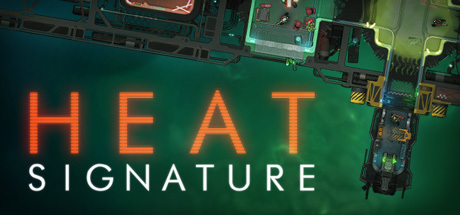
Reviewers commonly describe Heat Signature as immediately absorbing and addictive, but many report that repetition sets in after the initial wow moments. The strongest profile is initial fun followed by a decline, not a delayed click or a complete failure to click.
Friction: Tedious tutorial action exercise; Insufficient tutorial and system explanation; Repetitive mission structure; Limited mission variety; Barebones story and optional dialogue.
Unlock drivers: Meta progression makes later characters easier; Learning a mission beforehand lets players choose the right tools; Better equipment and growing boldness as players progress.
Player profiles
Creative Sandbox Roleplayer: Improvises with gadgets and stealth tools, sets personal rules or story goals, and experiments with multiple solutions. Motivation: Creative self-expression through emergent systems and personal character stories. Stance: buy.
Twitch Challenge Seeker: Fast, aggressive runs with time-slow planning, gadget combos, and risky improvisation. Motivation: Mastery and adrenaline from high-difficulty, high-speed action. Stance: buy.
Completionist Meta-Progression Grinder: Efficient repeated runs, min/maxing mission time and gear, and retiring characters to advance meta-progression. Motivation: Completing achievements and unlocking persistent progression. Stance: buy.
Platform notes
Steam Deck: The audit finds a split Steam Deck profile. Most quoted reviews describe a seamless and controller-friendly Deck experience, but one user explicitly cannot get the game to work on Deck and another notes unclear compatibility status. Because a launch failure is present, the friction score falls in the broken range even though several users report excellent performance.
Other review notes
From Gunpoint developer Tom Francis: Several reviewers note the game is made by the same developer as Gunpoint, Tom Francis of Suspicious Developments. It is often described as a follow-up or improvement on Gunpoint's formula.
Hotline Miami in space: Many reviewers describe the game as Hotline Miami in space, often noting top-down action and procedural generation. Some highlight added depth and complexity compared to that formula.
Around 20 hours first run: Multiple reviewers report a full first run takes around 20 hours, with some variations like 18 or 10 hours.
Minimal story and dialogue: Multiple reviewers note the game has almost no story, with little dialogue and few NPCs. The narrative is described as barebones or nearly non-existent.
Compared to Superhot: Some reviewers compare the game to Superhot, particularly for its time manipulation mechanics, though noted as more intense. Others mention Superhot for movement.