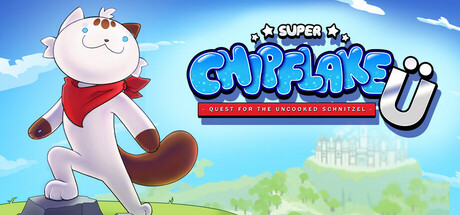
Super Chipflake Ü: Quest for the Uncooked Schnitzel Review Summary
- Fun exploration and open world
- Exceptional music and soundtrack
- Creative and cozy atmosphere
- Charming and humorous design
- Frequent bugs and softlocks
- Gameplay feels unpolished
Emotions
Archetypes
What players like:
Common complaints:
Gameplay feedback:
Performance notes:
Recommendations:
Other player notes:
Similar games
Blend with other games



Review evidence
Why players say this
Review evidence
Why players say this
Steam review verdict
A charming and cozy open world with exceptional music and fun exploration, but frequent bugs, softlocks, and unpolished gameplay hold it back.
What players like
Fun exploration and open world: The world is enjoyable to explore, with open-world design encouraging discovery through varied quests and characters. Players find exploration fun and rewarding.
Exceptional music and soundtrack: Players consistently praised the game's music, describing it as magnificent, brilliant, and blending perfectly with the gameplay. The soundtrack is considered a standout feature with many memorable tracks.
Creative and cozy atmosphere: The game is described as creative, cozy, and comfy, with a lovingly designed atmosphere. It provides a warm and inviting experience.
Charming and humorous design: The game is filled with charm and humor, with players noting lots of details, great atmosphere, and funny elements throughout. The overall experience is described as charming and funny.
Engaging and fun minigames: The minigames are a highlight, described as interesting, cool, and super fun. They offer variety and unique quests, including specific minigames like mini golf.
Common complaints
Frequent bugs and softlocks: Multiple reviews report numerous bugs and softlocks, including getting stuck in houses and geometry issues, though most are fixed.
Price considered too high: Multiple reviews state that 20 euros is too much for the game's perceived value, given its limited content and short length.
Gameplay feels unpolished: The game is described as unfinished and lacking refinement, with mechanics not fully polished. This suggests a rough early state.
Wanted more content: Players feel the game is lacking in amount of content, with many wishing for more to do beyond the main story.
Too many fetch quests: A large portion of side content is made up of fetch quests, which many reviewers find repetitive and uninteresting.
Gameplay and performance
3D platformer with collectathon: The game is a 3D platformer with open-world exploration, collecting items, and completing quests. It features minigames and a classic quest-based structure reminiscent of earlier collectathon games.
Grapple hook and speed upgrades: Players use a grappling hook and speed shoes to navigate the world, with upgradeable movement abilities that add complexity to the gameplay.
Fetch quests as core gameplay: Many missions involve fetch quests, which some players find repetitive but are central to the game's loop.
Main quest: collect schnitzel ingredients: The primary goal is to collect various ingredients to make a schnitzel, driving exploration and item gathering across the world.
Inspired by N64/GameCube platformers: The game draws clear inspiration from classics like Banjo-Kazooie and Mario 64, capturing the feel of 90s 3D platformers.
Excellent Steam Deck performance: Many users report flawless performance on the Steam Deck, with stable 60fps and high settings. The device handles the game well with full details and high resolutions.
Runs on low-end hardware: The game performs smoothly on older and weaker PCs, including 15-year-old laptops and low-end specs. This highlights good optimization for a wide range of systems.
Stable 1080p60 on Switch: Multiple reviews confirm the game runs at a consistent 1080p resolution and 60 frames per second on Nintendo Switch hardware. This indicates solid optimization for the platform.
Optimized for multiple platforms: Reviews indicate the game is well-optimized for both Switch and PC, with specific attention to performance. The design is tailored to the Switch but works well elsewhere.
Consistent high frame rates: Players report stable 60fps on various settings and devices, from low to high. This shows the game maintains good performance across different configurations.
Recommendations
Highly recommended overall: Many players strongly recommend the game, praising its value, quality, and length, with clusters 1, 3, 5, and 28 giving high importance scores. The game is seen as worth the investment and suitable for various audiences.
Recommended for platformer fans: The game is particularly recommended for fans of relaxing 3D platformers like Banjo-Kazooie and Mario 64, as well as those who enjoy collectathon mechanics and charming humor, as highlighted in clusters 2, 8, and 97.
Worth buying at full price: Some players feel the game is worth the full price due to its quality and length, while others advise waiting for a sale, as noted in clusters 4, 9, and 66. The importance reflects a split opinion on pricing.
Recommended for cozy and cute game lovers: The game is highly recommended for players seeking a friendly, cute, and relaxing experience, especially fans of indie and cozy games, as per clusters 5, 55, and 91. It offers a low-stress, charming adventure.
Not recommended in current state: Several reviews advise against buying the game at its current price or state, citing needs for fixes and more content, as shown in clusters 15, 60, and 102. This feedback is crucial for developers.
Buying context
Community fair range: $10.00 - $20.00.
Game completion: 8.0h.
Story completion: 5.0h.
The game starts slowly and boringly for about 30 minutes, but becomes highly fun once players obtain the speed shoes and grappling hook, which enable fast, addictive movement and exploration.
Reported time to anchor: 30m.
Friction: default movement is unbearably slow and tedious; lack of direction on where to go; fetch quests can feel repetitive; first 30 minutes feel too slow and boring; confusing progression without explanation; initial item carrying is tedious.
Unlock drivers: speed shoes for fast movement; grappling hook for vertical and distance traversal; tutorial improvements after patches; item merging mechanic adds depth.
Player profiles
Chill Collectathon Explorer: Explores the world at a leisurely pace, completes side quests, gathers collectibles, and enjoys the quirky atmosphere without pressure. Motivation: Relaxation and stress relief through casual exploration and collection. Stance: buy.
Nostalgic Platformer Veteran: Engages with the game as a love letter to classic platformers, actively spotting references, appreciating old-school aesthetics, and enjoying the lighthearted humor. Motivation: Nostalgia and appreciation for classic platformer design, references, and whimsical world-building. Stance: buy.
Quality-Conscious Skeptic: Evaluates the game's technical polish and quality-of-life features; may wait for patches or sales before committing or recommending. Motivation: Desires a complete, bug-free experience with essential features (e.g., save files) before supporting the game fully. Stance: no buy.
Platform notes
Steam Deck: The game is generally well-optimized for Steam Deck with smooth 60FPS gameplay, but some users face minor barriers such as manual Proton version selection and a resolved lack of cloud saves. A single report of persistent crashes indicates a potential compatibility issue for some users.
Linux and Proton: Based on the available user feedback, the game functions well on Linux with Proton 9. The only tweak mentioned is selecting the correct Proton version, and no crashes, performance problems, or anti-cheat blockers are reported.
Other review notes
Resolution fix requested: Players specifically requested a fix for the game's resolution settings. This indicates a display or graphical issue that needs addressing for proper gameplay experience.
Not AI related issue: This cluster appears to reference an unrelated or non-AI topic in the feedback. It is a short, vague note that does not clearly connect to common gameplay or technical issues.