- Good graphics and scenery
- Fun and enjoyable gameplay
- High potential, promising game
- Performance and optimization issues
- Missing quality of life features
- Building and snapping frustrations
Emotions
Archetypes
Hardware
What players like:
Common complaints:
Gameplay feedback:
Performance notes:
Recommendations:
Other player notes:
Similar games
Blend with other games






Review evidence
Why players say this
Review evidence
Why players say this
Steam review verdict
Good graphics and fun gameplay give this promising game high potential, but performance issues, missing quality of life features, and frustrating building snapping hold it back.
What players like
Good graphics and scenery: Reviewers frequently praise the game's visuals, including landscapes, scenery, and overall graphical quality. Cluster 1 highlights good graphics and music, while Cluster 5 specifically praises beautiful landscapes and environments.
Fun and enjoyable gameplay: Many reviewers find the game fun and enjoyable, with comments about having a good time playing alone or with friends. Cluster 6 and Cluster 15 reflect general enjoyment, while Cluster 7 shows strong liking for the game.
High potential, promising game: Reviewers consistently see great potential in the game, even in its current state. Clusters 3, 12, and 17 all emphasize the game's promising concept and core idea.
Exciting exploration and discovery: Exploration is a major source of enjoyment, with many neat things to discover. Cluster 16 highlights exciting exploration, and Cluster 18 mentions lots of exploration and discovery. Cluster 9 adds that ziplines enhance exploration and scenery viewing.
Engaging combat system: Combat is repeatedly described as fun, engaging, and surprisingly deep. Cluster 4 focuses on combat enjoyment, and Cluster 10 compares it favorably to Satisfactory, noting more intense and frequent combat.
Common complaints
Performance and optimization issues: The game runs poorly even on high-end hardware, with low FPS, lag, and optimization problems. Performance degrades especially in late game or with large bases.
Missing quality of life features: The game lacks many convenience features such as a hotbar, recipe icons, adjustable autosave intervals, and farming, which hampers the overall experience.
Building and snapping frustrations: Building mechanics are janky, with unstable snapping, limited rotation, and a frustrating interface. The building menu is slow and lacks hotkeys, making construction tedious.
Frequent crashes and instability: Players report persistent crashes, including during autosave, loading saves, and random gameplay moments, often leaving the game unplayable. This is one of the most common and severe complaints.
Widespread bugs and glitches: Many reviews mention a high number of bugs, ranging from minor annoyances to severe issues that break gameplay. The problem is pervasive across the game.
Gameplay and performance
Factory building core: Players frequently describe the game as a factory-building game, similar to Satisfactory and Factorio. Building and automating production lines is central to the experience.
Co-op and multiplayer support: Many reviews highlight the availability of co-op and multiplayer modes, including switchable single-player and multiplayer with shared save progress. Dedicated servers are also supported for multiplayer sessions.
Combat against bug enemies: Combat revolves around fighting bug-themed enemies, including swarms and ranged mobs. Weapons include pistols, rifles, shotguns, and heavy machine guns.
Base building with foundations: Building placement involves foundations, pillars, and snapping mechanics, sometimes with janky requirements. Players can construct bases with floors, platforms, and structural stability.
Survival gameplay elements: Survival aspects include hunger, thirst, hunting for food, and exploring hostile terrain. The game combines survival with factory building on an alien planet.
Frequent Random Game Crashes: Players report constant, random crashes that can occur after a few hours or within minutes, making the game unplayable for some. This is a widespread issue mentioned across multiple clusters.
Crashes Linked to Autosave: The autosave feature frequently causes freezes, stutters, and crashes, sometimes making the game unplayable. Some players note that disabling autosave mitigates the issue.
Late Game Performance Degradation: Performance worsens as the game progresses, with terrible lag in mid-to-late game and after hundreds of hours. Multiplayer sessions are also affected.
Lag During Building Placement: Placing buildings causes significant lag, especially as the base grows with many foundations. This also leads to freezes when using the build menu or right mouse button.
Launch Failures and Unreal Crashes: Some players experience initial launch failures with Unreal crash reports, requiring multiple relaunches. Others cannot launch under Proton on Ubuntu or SteamOS.
Recommendations
Currently not recommended by many: A significant number of players explicitly advise against buying or recommending the game right now. Common reasons include bugs, crashes, and an incomplete early access state.
Appeals to factory game fans: Many reviewers compare it favorably to Satisfactory and Planet Crafter, recommending it for fans of those games. It is especially appealing to players who enjoy base building, automation, and resource management.
Mixed feelings on early access: Some recommend it in its current early access state but note it needs significant work and may not hold up as a full release. Others suggest waiting until it leaves early access before buying.
Generally recommended by players: Many reviewers give a straightforward recommendation, calling it fun, addictive, and a great game. Some recommend it especially for playing with friends.
Crashes make game unplayable: Players report frequent crashes that render the game unplayable and strongly recommend against purchase until fixed. Some state they would recommend it once the issue is resolved.
Buying context
Community fair range: $15.00 - $20.00.
Game completion: 50.0h.
Story completion: 20.0h.
Session length: 3.0h.
Endgame: 100.0h.
StarRupture often lands an early hook through exploration, base building, and co-op, but the dominant reported arc is enjoyment fading into repetitive grind and tedium. It can still work for genre fans who tolerate Early Access issues and later unlock-driven improvements.
Friction: Long on-foot traversal and backtracking between bases; Tutorial does not explain core movement and systems; Building placement and snapping feel slow and clunky; Missing QoL such as hotbar, quick inventory transfer, and clear recipes; Co-op bugs, desync, and lost guest progress; Repetitive exploration and combat.
Player profiles
Satisfactory/Factorio Automation Veteran: Designs and scales sprawling production lines, scrutinizes logistics and building freedom, and pushes for blueprints and working rails. Motivation: Scratching the automation itch by building and optimizing large, efficient factory complexes. Stance: deep sale.
Co-op Social Builder: Plays in 2-4 player sessions, divides tasks across the base, and embraces glitches and disasters as part of the group fun. Motivation: Sharing the building and survival experience with friends and enjoying emergent cooperative chaos. Stance: buy.
Solo Survival Combat Explorer: Plays solo, builds outposts, explores biomes, and fights PVE enemies while struggling against co-op-oriented difficulty scaling. Motivation: Exploring a hostile alien world, fighting alien waves, and surviving its hazards. Stance: sale.
Platform notes
Among the six largest Windows hardware cohorts, higher-VRAM 32GB+ systems generally report better performance, while lower-VRAM and lower-RAM systems more often suffer from stutter, freezes, crashes, and optimization problems; mid-range 16-31GB RAM cohorts are mixed.
Windows 12-15GB VRAM / 16-31GB RAM: mixed. Reports are split: some users get high frame rates and smooth play, while others report late-game stutter, frame drops, crashes, and severe optimization problems.
Windows <8GB VRAM / 16-31GB RAM: mixed. Some users report stable performance even with large factories, but many others describe frame drops, freezes, crashes, and lag when building or expanding.
Windows 8-11GB VRAM / 16-31GB RAM: negative. Performance problems dominate, with frequent freezes, stutters, crashes on save, and poor optimization reported even by users who recommend the game.
Steam Deck: User feedback shows the Steam Deck and Linux experience suffers from tiny unreadable UI, frequent crashes, missing controller support, Proton tinkering, and late-game performance collapse. Although some users report the game runs on Steam Deck, the overall handheld experience is high-friction and falls into the broken range.
Linux and Proton: The majority of Linux users report that StarRupture runs well via Proton, often with no changes from default settings. However, a noticeable minority experiences Linux-specific issues including crashes, instability, launch failures on some distributions, and an input bug on Linux Mint. Additionally, dedicated server binaries are only available for Windows, which limits Linux-based server hosting. Overall, the game is mostly compatible with Linux but has friction for some users.
Extra review signals
Monetization: The audit found direct evidence of real-money lootboxes and pay-to-win DLC in the reviews, including a claim that the unfinished game already offers purchasable lootboxes and multiple reports that paid DLC grants best-in-slot gear. Other reviews dispute P2W by pointing to PvE or optional co-op and in-game obtainability, and many describe DLC as optional support. Base-price complaints are present but excluded from the MTX score. Because the evidence passes the real-money gate for paid randomized rewards and purchased power, the score falls in the predatory range.
Mod reliance: The filtered reviews center on optional, community-made enhancements for the early-access title StarRupture: font/HUD readability tweaks and inventory/stack size mods, plus general praise for having mod support so early. No review describes crashes on startup, launch failures, or broken quests in the vanilla game. The 'mandatory' or 'needed to play' framing lacks any concrete bug, matching the hyperbole-filter rule, and complaints about mod loaders/managers are absent. Evidence supports a fully playable base game where mods are preferences rather than fixes.
External guides: The dataset is dominated by a Tier 2 'Hoarder' pattern: users repeatedly need crafting/recipe data and inventory or spreadsheet support that the game only exposes awkwardly (e.g., by building a factory to view material requirements), driving demands for an in-game encyclopedia or recipe book. Tier 3 instructional gaps (weak tutorial, wiki/Google-dependent mechanics) and Tier 4 alt-tab crash bugs also recur, while a minority reports the game is fully playable without external data. No explicit Tier 1 evidence for farming, drop rates, or loot tables was found, so per strict priority the presence of Tier 2 keywords yields a score of 75.
Other review notes
Frequent Satisfactory Comparisons: The game is constantly compared to Satisfactory, often described as a similar factory-building game with its own unique twists and style. Some call it a clone while others see it as a fresh take on the genre.
Early Access Development State: Many reviewers note the game is currently in Early Access, Alpha, or Beta, with content still being polished and slowly updated. Some mention a full release expected around 2027.
Comparisons to Factorio and Subnautica: Beyond Satisfactory, the game is also compared to Factorio for its automation and Subnautica for its survival and exploration aspects. These comparisons highlight its blend of genres.
Unique Survival and Combat Twist: Unlike Satisfactory, this game includes more developed survival, combat, and exploration elements, with hostile creatures and base defense mechanics. The solar eruption mechanic adds a distinctive challenge.
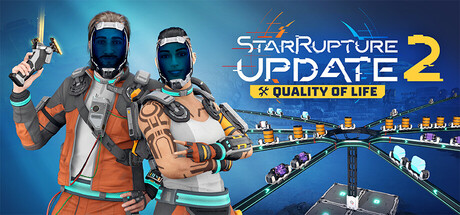
Polished for Early Access: Despite being in Early Access, the game is surprisingly well-polished, with excellent graphics and sound. Update 2 was a significant addition that improved quality-of-life features.