- Expands vehicle engineering possibilities
- Deployable science and surface features
- DLC adds immense value
- Many bugs remain unfixed
- Robotic parts are unstable
- Content feels incomplete
Emotions
Archetypes
What players like:
Common complaints:
Gameplay feedback:
Performance notes:
Recommendations:
Other player notes:
- -
No data available
Similar games
Blend with other games 80%Kerbal Space Program: Making History Expansion
 78%Oxygen Not Included - Spaced Out!
 76%Besiege: The Broken Beyond
 75%Factorio: Space Age
 74%RimWorld - Odyssey
 73%Tropico 6 - New Frontiers
 72%Starfield - Terran Armada
 71%X4: Tides of Avarice
 71%LEGO® Worlds: Classic Space Pack
 71%Oxygen Not Included
 71%Kerbal Space Program
 71%Stellaris: First Contact Story Pack
Review evidence
Why players say this
Review evidence
Why players say this
Steam review verdict
Expands vehicle engineering with deployable science and surface features, and the DLC adds immense value, but many bugs remain, robotic parts are unstable, and content feels incomplete.
What players like
Expands vehicle engineering possibilities: Players can now build complex vehicles with moving parts like folding solar panels, walking rovers, swing wings, internal weapons bays, and even a giant robotic octopus. This greatly enhances the sandbox element.
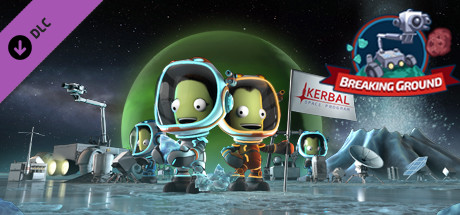
Deployable science and surface features: The new deployable science experiments and ground surface features (craters, cryovolcanoes, geysers) give players more reasons to explore planets, build rovers, and set up bases. Players find these features fun, polished, and they make the game world feel more alive.
DLC adds immense value: Many players consider the DLC essential and a fantastic expansion that adds hundreds of hours of gameplay. It revitalizes the game, especially for veteran players, and is often compared favorably to the Making History DLC.
Enables propeller aircraft and helicopters: Players appreciate the ability to create functioning propeller aircraft, helicopters, and drones using the new motors and blades. These builds are described as rewarding and fun, opening up new aviation possibilities.
New science instruments are useful and fun: The new science equipment, like the robotic analysis arm, soil experiments, seismic sensors, and weather stations, adds more depth to scientific missions. EVA deployable science is noted as both useful and entertaining.
Common complaints
Many bugs remain unfixed: Numerous bugs from the base game, such as orbit warp glitches and symmetry placement issues, persist in this DLC. Long-standing problems have not been resolved even years after release.
Robotic parts are unstable: Robotic parts such as hinges, pistons, and rotors are frequently described as wobbly, flimsy, and prone to glitching or breaking under load. This makes complex creations like tilt rotors or swing wings impractical.
Content feels incomplete: The DLC is described as lacking polish, with only about 40 parts, poor sound effects, missing tutorials, and features that do not spawn on older saves. Many feel it should have been included in the base game.
Price is too high: Players consistently report that the DLC is overpriced, with $14.99 being seen as unreasonable. Many suggest a price of $5-8 would be more appropriate, and the value is poor compared to the base game.
Robotic parts are user-unfriendly: Setting up robotic parts is confusing, with unclear explanations, no numeric input for angles, and poorly designed action groups. The interface is small and lacks clarity.
Gameplay and performance
Robotic parts expansion: The DLC introduces a wide variety of robotic parts including hinges, pistons, rotors, servos, and controller systems. These parts allow players to build moving structures such as helicopters, propellers, and mechas.
New science experiments: Several new science experiments and deployable science stations are added, enabling players to gather data through surface bases, soil samples, and even seismic sensors. Some experiments generate science over time or can be triggered by crashing ships.
Control and automation systems: Players can use the KAL-1000 controller and other automation tools to create analog control groups, command loops, and symmetry for robotic parts. This adds precision and repeatability to complex builds.
Surface features and objects: The DLC introduces new planetary surface features like cryovolcanoes, rock formations, and dunes, along with objects that can be discovered and interacted with. These features are generated only at the start of a playthrough.
Enhanced building and assembly: New building modes add dedicated robotics and cargo tabs, along with rotate/translate functions for parts. The inventory system is also expanded, allowing more flexible vehicle construction.
DLC loading causes crashes: The game crashes and causes a blue screen when attempting to load DLC, suggesting a serious compatibility or stability issue with the new content.
Engine struggles with new content: The game engine struggles to handle new content, leading to performance issues and instability.
Recommendations
Mostly recommended DLC: The majority of feedback strongly recommends this DLC, especially for fans of the main game, with many calling it essential or a must-buy.
General strong recommendation: A large portion of feedback is unequivocally positive, calling the DLC a must-have, highly recommended, or an essential purchase.
Recommend on sale: A significant number of reviewers suggest waiting for a sale before purchasing, citing the price as too high at full cost.
Wait for discount before buying: Many reviewers suggest that the DLC is only good value when purchased on discount, not at full price.
Mods are better alternative: Many users feel the DLC's robotic parts are inferior to free mods like Infernal Robotics, and recommend mods instead.
Buying context
Community fair range: $10.00 - $20.00.
Players report a steep learning curve, slow science progression, and tedious interface actions, with early enjoyable features being fleeting or locked behind DLC, leading to a recommendation against the game for progression seekers.
Friction: Long learning curve requiring external tutorials; Slow and boring deployed science activities; Tedious interface for deleting messages; Early promising feature ends too quickly; Progression modes unrewarding for time invested.
Unlock drivers: Patience to endure long learning curve; External tutorial videos (lack of adequate in-game tutorials in some languages); Use of specific DLC parts (e.g., Juno-engine VTOL).
Player profiles
Build-Crafter Engineer: Builds complex craft with robotics, iterates designs to overcome physics quirks, and seeks new construction methods. Motivation: Creative challenge and solving engineering puzzles. Stance: sale.
Science Collector Explorer: Methodically collects science from all available biomes using new experiments, treats science points as progression currency. Motivation: Science progression and exploration completion. Stance: sale.
Critical Quality Seeker: Cautious, avoids buggy parts, compares DLC content to mods, and withholds recommendation until technical issues are resolved. Motivation: Value for money and polished gameplay experience. Stance: no buy.
Extra review signals
Monetization: The user feedback for Kerbal Space Program's DLC (Breaking Ground) focuses entirely on traditional DLC pricing and the practice of converting a popular mod into paid content. There is no evidence of microtransactions, pay-to-win mechanics, loot boxes, or any form of predatory monetization. The complaints are about value for money, which falls under base-price dissatisfaction and does not indicate a greedy or casino-like system. The monetization model is entirely based on one-time DLC purchases with no in-game shops or currencies.