- Stronger than original game
- Excellent philosophy introduction
- Charming characters and dialogue
- Funny and witty humor
- Philosophical content lacks depth
- Weak frame story and ending
Emotions
Archetypes
What players like:
Common complaints:
Gameplay feedback:
Performance notes:
- -
No data available
Recommendations:
Other player notes:
Similar games
Blend with other games 73%Prime Monster
 72%Trials of Innocence
 72%The Talos Principle 2
 71%Danganronpa V3: Killing Harmony
 71%The Trolley Solution
 71%Murders on the Yangtze River
 71%The Life and Suffering of Prince Jerian
 71%The Stanley Parable: Ultra Deluxe
 71%AI: THE SOMNIUM FILES - nirvanA Initiative
 71%Everything
 71%Road 96 🛣️
 71%The Legend of Heroes: Ao no Kiseki KAI
Review evidence
Why players say this
Review evidence
Why players say this
Steam review verdict
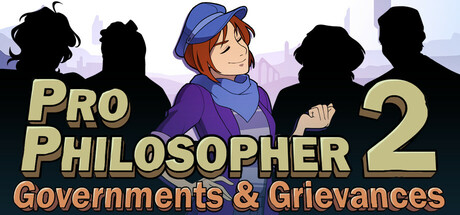
Stronger than the original, with charming characters, witty humor, and an excellent philosophy intro, though its philosophical depth, frame story, and ending fall weak.
What players like
Stronger than original: Reviewers consistently say the sequel improves on the first game, with more polish, bolder design, and more content. Many describe it as a refined follow-up that surpasses the original.
Excellent philosophy introduction: The game is praised as an accessible and engaging entry point to political philosophy and complex philosophical ideas. It works well for players new to the subject.
Charming characters and dialogue: The characters are fun, likeable, and have enjoyable dynamics. Dialogue is often highlighted as a strong point.
Funny and witty humor: The jokes and humor are consistently found entertaining, with many laugh-out-loud moments. The writing is snappy and witty.
Encourages critical thinking: Reviewers highlight that the game promotes critical thinking through its mechanics and content. It pushes players to analyze and reflect on ideas.
Common complaints
Philosophical content lacks depth: Reviewers consistently note that the exploration of philosophers' thoughts is not deep, with content being very surface-level and oversimplified. Some feel it relies on Cliff Notes versions of thinkers' ideas and their common downsides.
Weak frame story and ending: The frame story is considered weaker than the first game's, and the ending is a bit worse. Some find the final debate slightly predictable and the final message about critical thinking not strong given the weighty subject matter.
Gameplay fatigue and repetitive mechanics: Players got pretty fatigued with the gameplay by the end due to wanting to use all three press buttons to see all dialogue. The game loses a lot of the classic Phoenix Wright charm and engages less with holistic arguments.
Inaccessible text and visuals: Several clusters highlight accessibility issues, including no accessibility options in a text-based game, frequently inaccessible text, and light green text on a tan background. The game is reportedly not playable for low vision gamers.
Mixed art and character quality: The art is a mixed bag, and the drama doesn't work much with mixed characters. The story could have had more depth, and the depiction of the second philosopher was perhaps too harsh.
Gameplay and performance
Ace Attorney-Style Philosophical Debates: The game is heavily inspired by Ace Attorney, using cross-examination mechanics adapted to philosophical arguments. Players press for clarification and challenge statements to refute philosophers' worldviews.
Political Philosophy Focus: The game centers on political philosophy rather than morality, covering systems of governance and political models like socialism, democracy, and libertarianism. It features debates with political philosophers on how governments should be structured.
Socratic Dialogue Structure: The game uses a series of Socratic dialogues where players examine arguments and use logic to point out internal inconsistencies. Argumentation and rebuttal mechanics form the core of the experience, encouraging critical thinking.
Visual Novel Format: The game is presented as a visual novel with point-and-click adventure elements. It follows a text-based format with story segments interspersed between debate sections.
Historical Philosopher Debate Opponents: Players debate against historical philosophers such as Marx, Locke, Frantz Fanon, Lenin, Kropotkin, Rawls, and Nozick. The game features a new set of philosophers compared to the original, with chapters focusing on different thinkers.
Recommendations
Play the first game first: A large number of reviewers strongly recommend playing the original free game before this sequel, saying enjoyment of the first game is the best predictor of liking this one and that it serves as a good primer.
Strongly recommended overall: A broad set of reviewers give the game an unqualified recommendation, telling others to pick it up, buy it, or that there is no reason not to play it.
Appeals to Ace Attorney fans: Multiple reviewers recommend the game specifically to fans of the Ace Attorney series and similar visual novel or attorney-style games, noting it fits that genre well.
Great for philosophy newcomers: Reviewers highlight that the game is excellent for people unfamiliar with philosophy, including young teens, students, and those who never attended a philosophy class, serving as an accessible primer.
Engaging for philosophy enthusiasts: Those who already know philosophy may still find the game charming, and it is described as a must-play for philosophy and politics enjoyers, piquing interest in political philosophers.
Buying context
Community fair range: $5.00 - $15.00.
Game completion: 4.5h.
Story completion: 4.5h.
Session length: 0.5h.
Player profiles
Returning Sequel Veteran: Plays the first game first, then compares the sequel's length, themes, and narrative to the original. Motivation: Continue the story and see how the sequel builds on the first game. Stance: buy.
Ace Attorney / Visual Novel Enthusiast: Plays dialogue-heavy visual novels and compares the game to the Ace Attorney series. Motivation: Experience a fun, Ace Attorney-style visual novel with strong dialogue and narrative. Stance: buy.
Philosophy and Debate Seeker: Plays for dialogue and debate, often discussing the game's ideas with someone else. Motivation: Engage with philosophical debates and thought-provoking topics. Stance: buy.
Other review notes
Sequel to Pro Philosopher: The game is a direct sequel to Socrates Jones: Pro Philosopher, continuing the story and refining the mechanics. It builds on the original's spirit and expands the world building.
Educational philosophy focus: The game teaches basic philosophy, logic, and rhetoric, with educational potential applicable to everyday life. It serves as an introductory tour to political philosophy and critical thought tools.
Comparisons to Ace Attorney: Many reviewers compare the game to the Ace Attorney series, noting similar courtroom interrogation and cross-examination mechanics. It is described as an 'Ace Attorney-like' with a unique philosophical twist.
Political philosophy coverage: The game covers political philosophy, including philosophers like Machiavelli, Rawls, Nozick, Marx, Fanon, and more. It addresses topics such as revolution, systemic oppression, classism, and colonialism.
Free first game available: The first game in the series, Socrates Jones: Pro Philosopher, is free to play on Steam and other platforms. It lasts about 1-2 hours and serves as a great introduction to the sequel.