- Deep creative circuit design capabilities
- Intuitive and user-friendly interface
- Excellent learning resource for logic
- CPU and processor design integration
- Lack of beginner tutorials and guidance
- No structured gameplay or clear goals
Emotions
What players like:
Common complaints:
Gameplay feedback:
Performance notes:
Recommendations:
Other player notes:
Similar games
Blend with other games





Review evidence
Why players say this
Review evidence
Why players say this
What players like
Deep creative circuit design: Players highlight the game's open-ended environment for designing complex digital circuits, praising its flexibility and creative potential. The pixel-based approach and lack of sub-circuits allow for full visibility and innovation in circuit building.
Intuitive and user-friendly UI: The interface is clean, color-coded, and packed with hotkeys, making it accessible for beginners while remaining powerful for advanced users. Players appreciate its simplicity and effectiveness.
Excellent learning resource: The game is an effective tool for learning digital logic, computer architecture, and circuit design. It includes a helpful manual, well-designed examples, and is beginner-friendly while covering advanced topics.
Visually appealing pixel art: The pixel-based design is not only functional but also aesthetically pleasing, allowing for customizable components and a unique visual style that players enjoy.
Built-in assembly and memory tools: The game includes a well-designed internal assembler and supports custom instruction sets, enabling players to create assembly language from scratch and run code against components. This adds depth for advanced users.
Common complaints
Lack of beginner tutorials: Multiple clusters highlight the absence of guided tutorials or onboarding for new players, making the game overwhelming and unsuitable for beginners. This includes missing step-by-step instructions and examples.
No structured gameplay or goals: The game lacks predefined goals, challenges, or narratives, making it feel more like a sandbox tool than a game. Players seeking entertainment or progression may find it unsatisfying.
Redstone and circuit limitations: Redstone mechanics are frustrating due to static placement, signal delays, and the need for repeaters. Logic gates also suffer from tick-based delays, causing synchronization issues.
Limited modularity and IC support: Players criticize the lack of integrated circuits (ICs), custom subcircuits, and modularization, which restricts the complexity and scalability of builds. Pre-compiled ICs are also missing.
Small and restrictive canvas: The limited canvas size (2048 pixels) and board restrictions hinder creativity and large-scale projects. Players also request a larger or customizable workspace.
Gameplay and performance
CPU and processor design capabilities: The game enables users to design custom CPUs, processors, and integrated circuits (ICs), including memory units and assembly code support. This is highlighted as a key feature for learning computer architecture.
Educational focus on logic and circuitry: The game serves as a learning tool for Boolean logic, binary systems, and computer architecture, with tutorials, documentation, and example projects (e.g., half adders, 4-bit ALUs). It is compared to educational games like Turing Complete.
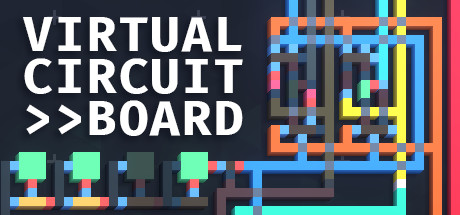
Pixel-based circuit design interface: The game features a pixel-based UI for designing circuits, resembling a paint program. Users appreciate the ability to customize logic gates and components, though some desire improvements like multi-layer circuits and customizable board sizes.
Comparison to redstone and other games: Users frequently compare the game to Minecraft's redstone mechanics, Factorio's logistics, and other circuit-building games like Turing Complete or Logic World, noting its educational and sandbox strengths.
Manual wiring and assembly integration: The game requires manual wiring for circuits, with support for assembly language editing and memory units. This appeals to users interested in low-level programming and hardware design.
Exceptional simulation performance: The game delivers lightning-fast simulation speeds, handling millions of ticks per second and complex circuits without lag. Players highlight its stability even with thousands of components, making it stand out in performance.
Optimized for large-scale designs: The game is well-optimized, running smoothly for complex schemes and large circuits. Players note its efficiency compared to other games, with minimal performance limitations.
GPU computing integration: The game leverages GPU computing for improved performance, though some players report high GPU usage even when not simulating. This may impact system resources for certain setups.
Linux compatibility issues: The Ink Switch menu does not work under Linux, though the game otherwise runs flawlessly on the platform. This may affect usability for Linux users.
Minor UI quirks: Players report minor issues with copy/paste and undo/redo functions, which can disrupt workflow. These quirks are noted as part of the Early Access polish.
Recommendations
Ideal for logic circuit enthusiasts: The game is highly recommended for players who enjoy redstone mechanics, digital logic gates, and assembling computers from logic circuits. It appeals to those with experience in electronics, hardware engineering, or programming.
Educational value for digital design: The game is recommended for modern digital systems design classes and as a digital circuit simulator. It is praised for its potential in teaching digital logic and computer architecture.
Appeals to problem-solvers and tinkerers: The game is recommended for those who enjoy solving problems, tinkering with technology, and building circuits from scratch. It encourages creativity and hands-on learning.
Improved debugging and simulation tools: Players suggest adding better debugging tools, an accurate mode with no randomness, and a professional mode closer to real-world circuit behavior. These would enhance realism and usability.
Desire for modular and expansive features: Feedback includes requests for modularization, modular sub-circuits, an infinite board, and workshop support. These features would improve flexibility and creativity in circuit design.
Other review notes
Retro computing references: Mentions of the 8080 manual and comparisons to redstone (from Minecraft) indicate the game's appeal to enthusiasts of retro computing and logic-based systems.
Mod support in development: Players note that the game is nearing the end of its development cycle, with mod support currently being implemented. This suggests ongoing community engagement and potential for extended replayability.
Community-driven hardware projects: The game inspires creative community projects, such as running a 3D Doom-like game on a RISC-V CPU design. This highlights its appeal to technically inclined players and its potential for educational use.
Educational integration suggested: Players suggest implementing projects from nand2tetris, a well-known computer science educational tool, to enhance the game's learning value. This reflects demand for deeper educational features.
Space-efficient DIY computing: The game is praised for being useful for those interested in building computers from scratch but lacking physical space. This underscores its accessibility and practical applications for learning.