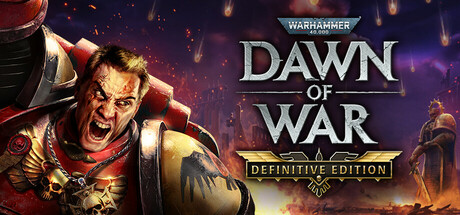
Warhammer 40,000: Dawn of War - Definitive Edition Review Summary
- Improved graphics and visuals
- Fun gameplay remains intact
- All campaigns and content included
- Bad pathfinding and unit AI
- Frequent crashes and performance issues
- Overpriced for limited content
Emotions
Archetypes
What players like:
Common complaints:
Gameplay feedback:
Performance notes:
Recommendations:
Other player notes:
- -
No data available
Similar games
Blend with other games 82%STAR WARS™: Battlefront Classic Collection
 81%Command & Conquer™ Remastered Collection
 81%Warhammer 40,000: Space Marine - Master Crafted Edition
 81%S.T.A.L.K.E.R.: Shadow of Chornobyl - Enhanced Edition
 79%Tales of Berseria Remastered
 79%Total War: SHOGUN 2 - Complete Edition
 78%Company of Heroes 3
 78%Dungeons & Dragons Neverwinter Nights 2: Enhanced Edition
 78%Stronghold Crusader: Definitive Edition
 78%FRONT MISSION 2: Remake
 78%Age of Mythology: Retold
 78%R-Type Tactics I • II Cosmos
Review evidence
Why players say this
Review evidence
Why players say this
Steam review verdict
Improved graphics and fun gameplay with all campaigns included, but bad pathfinding, frequent crashes, and overpricing for limited content hurt the experience.
What players like
Improved graphics and visual upgrade: Many players note that graphics, textures, lighting, and shadows have been improved. The remaster features AI-upscaled textures, revamped models, and better visual quality across the board.
64-bit support and performance: Full 64-bit support allows the game to use more than 4GB of RAM, utilize all CPU cores, and improves stability on modern hardware, including smoother alt-tabbing and reduced crashes.
Fun gameplay remains intact: The core Dawn of War experience is still highly enjoyable, with classic base-building, sync-kills, and explosive warfare. Many players express that the game is as fun as they remember and a joy to play.
Widescreen and resolution support: The remaster offers native widescreen, 2K, and 4K resolution support, fixing the old stretching issues and making the game playable on modern monitors. The improved camera allows zooming out more.
All campaigns and content included: The collection bundles all four campaigns, nine races, and all original expansions into one package. Players appreciate having all content accessible from a single launcher.
Common complaints
Bad pathfinding and unit AI: Units frequently get stuck, pathfinding is unreliable, and promised improvements were not delivered. Some players report that the new pathfinding is worse than the original.
Lack of WASD support: There is no WASD camera movement or mouse controls, and keybinding options are absent. This frustrates players used to modern RTS controls.
Unfixed original bugs persist: Many bugs from the original Soulstorm remain unaddressed, including balance issues and gameplay glitches. The remaster feels incomplete.
Overpriced for limited content: The price (17-30 EUR/USD) is considered too high given the minimal improvements and lack of new features. Players feel it offers poor value.
Frequent crashes and bugs: Players report crashes at launch, during campaign missions, and after matches. Stability issues heavily impact gameplay.
Gameplay and performance
Technical upgrades appreciated: Improvements like 64-bit architecture, dynamic shadows, texture upgrades, and Windows 10 compatibility are well-received.
Online mode lacks matchmaking: Online mode has no matchmaking and is dominated by veteran players, making it hard for newcomers.
Content packed in one launcher: All four campaigns and nine races are accessible from a single launcher, which is convenient but overwhelming.
AI gets unfair unit limits: The AI can send multiple Relic units while the player is limited to one, creating an imbalance.
Balance changes affect gameplay: Balance changes include increased melee charge and jump units being invulnerable during jumps, altering combat dynamics.
Single-core CPU bottleneck: The engine is repeatedly identified as using only one CPU core, causing severe performance issues in large battles. Players note this is the root cause of FPS drops and has not been addressed despite a 64-bit update.
Frequent crashes across modes: Crashes are reported in multiple contexts: during campaign missions, at loading screens, in custom lobbies, and in multiplayer. Some crashes are tied to mods, while others occur without mods.
Severe FPS drops in large battles: Players consistently report framerate collapsing to 10-30 FPS during large-scale battles, with drops from 53-60 FPS to as low as 10 FPS. This is the most frequent and detailed complaint, affecting both vanilla and modded gameplay.
Performance worse than original: Many players state the remastered or updated version runs worse than the original game, with worse optimization despite a 64-bit engine update. Degraded performance is a common theme.
64-bit update did not fix performance: Despite a 64-bit engine update that reduced crash risk when alt-tabbing, core performance issues remain. The update is seen as insufficient, with some claiming multithreading doesn't work.
Recommendations
Not recommended currently: A large number of reviews state the game is not recommended in its current unfinished or buggy state, with many requesting refunds or advising others to avoid purchase until fixes arrive.
Not worth for original owners: Players who already own the original 2004 game or earlier versions find the remaster a waste of money, as it offers little new content or improvement. This is the most frequent complaint across multiple clusters.
Wait for sale: Many reviewers advise waiting for a significant discount, often suggesting a price of $5-10 or 50% off, as the current price is not justified by the quality.
Wait for fixes and patches: Many reviewers recommend waiting for future patches to fix bugs, optimization, and missing features before considering a purchase.
Stick with original version: Many players recommend playing the original 2004 game or modded versions (like Soulstorm) instead of the remaster, as they offer a better experience and are more stable.
Buying context
Community fair range: $14.99 - $19.99.
Story completion: 20.0h.
Dawn of War Definitive Edition offers deep RTS gameplay but suffers from a poor tutorial, UI bugs, and multiplayer instability; fun emerges after players learn factions and mechanics, often through campaign or skirmish practice.
Friction: lackluster tutorial omitting key mechanics like unit cap; UI errors and graphical glitches; multiplayer crashes and desyncs; pathfinding issues; default Soulstorm ruleset locked in multiplayer; camera zoom limitations.
Unlock drivers: learning through campaign missions; skirmishing with different factions; playing with friends despite connectivity issues; appreciating the aggressive pacing and faction design.
Player profiles
Veteran Purist: Prefers the original versions, may upgrade only for mod support or on deep sale. Usually has hundreds of hours in the original and values the classic balance and campaign pacing. Motivation: Nostalgia and wanting to relive the original experience, but disappointed by lack of substantial upgrades beyond minor visual and UI tweaks. Stance: no buy.
Newcomer Enthusiast: Plays through all campaigns, explores skirmish, may not engage in competitive multiplayer initially. Often appreciates the improved graphics and UI. Motivation: Discovering a classic RTS and the Warhammer 40K universe; enjoying the rich campaigns and faction diversity. Stance: buy.
Competitive Player: Regularly plays ranked 1v1, cares about balance patches, may use exploits if available. Often compares to Soulstorm's competitive scene. Motivation: Seeking balanced, fair competitive play with anti-cheat and stable matchmaking. Stance: no buy.
Platform notes
Steam Deck: The remaster suffers from poor AI upscaling, inadequate UI scaling that forces manual workarounds, and occasional performance/stability issues, while lacking modern features expected from a remaster. Despite some positive notes on Steam Deck compatibility, the overall experience requires tinkering and falls short of expectations.
Linux and Proton: The user feedback dataset includes no Linux or Proton compatibility concerns. All reviews discuss generic game features and do not provide any evidence of Linux-specific friction, launch issues, or required tweaks.
Extra review signals
Monetization: Most user feedback labels the Definitive Edition as a 'cash grab' because it repackages old games with superficial updates, introduces new bugs, and charges existing owners for an upgrade. However, there is no evidence of in-game microtransactions, pay-to-win mechanics, or predatory monetization beyond the initial purchase price. The 'greed' alleged concerns the value proposition, not ongoing spending.