- Excellent with friends
- Addictive and engaging
- Twitch integration enhances experience
- Cannot hire staff solo
- Early access needs polish
- Frequent crashes and instability
Emotions
Archetypes
Hardware
What players like:
Common complaints:
Gameplay feedback:
Performance notes:
Recommendations:
Other player notes:
- -
No data available
Similar games
Blend with other games





Review evidence
Why players say this
Review evidence
Why players say this
Steam review verdict
Excellent with friends, addictive, and engaging Twitch integration, but early access suffers from crashes, instability, and the inability to hire staff solo.
What players like
Excellent with friends: Players highlight that the game is significantly more enjoyable when played with friends, emphasizing chaotic fun and cooperative experiences. Multiple clusters focus on this social aspect.
Addictive and engaging: The game is frequently described as addictive, with compelling gameplay that keeps players coming back. This is cited in multiple reviews as a key strength.
Excited for future updates: Players express anticipation for new content and updates, showing eagerness for the game's continued evolution. This reflects a positive sentiment towards ongoing support.
Zombies add fun twist: The inclusion of zombies is seen as a cool and interesting addition that adds extra enjoyment to the gameplay. This theme is noted as a positive feature.
Twitch integration enhances experience: The Twitch integration feature is noted as a unique and enjoyable addition, allowing stream viewers to interact and increasing engagement. This is a standout feature for many.
Common complaints
Cannot hire staff solo: Single-player mode lacks the option to hire employees, which is essential for managing tasks. This makes solo play harder and less viable, as players need support staff.
Early access needs polish: The game shows janky moments and minor bugs typical of early access, requiring improvements before full release. Players expect more refinement and stability.
Items disappear from inventory: Players report items vanishing from containers, storage, and inventory, including issues with items becoming invisible or disappearing when dropped. This affects inventory management and may be related to overflow or rendering bugs.
Hospital expansion becomes useless: Expanding the hospital with only one reception desk leads to inefficiency and empty spaces. Larger facilities lack purpose, making expansion feel wasted without additional support.
Lack of variety in events: The game suffers from limited event variety and depth, leading to repetitive experiences. Players want more diverse content to maintain interest.
Gameplay and performance
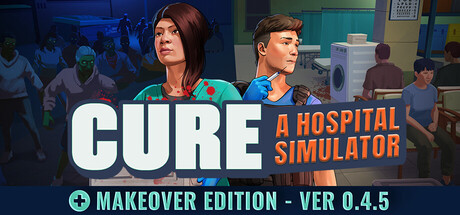
Zombie hospital management game: The game combines hospital management with zombie apocalypse and outbreak themes, where players must manage a medical facility while dealing with zombies as enemies and patient threats.
Zombie core gameplay element: Zombies are a main game element and feature, with players eliminating zombies and managing zombie-related threats, but some feedback notes they can cause issues like stopping patient flow.
Medical simulator core: The game is described as a medical simulator with diagnostic tools, mini-games for diagnosing, and patient treatment mechanics, fitting the hospital simulation genre.
Hospital design layout: Players can design and customize their hospital layout, including placing beds, shelves, and items for management.
Inventory system limits: The game includes a pocket inventory system with limited slots (e.g., 5 slots) and a shopping cart system for item management.
Frequent crashes and instability: Multiple clusters report crashes on startup, during loads, and throughout gameplay. This suggests a widespread stability issue affecting many users.
Lag worsens with game progression: Specific clusters describe lag spikes and stuttering that intensify around night 35 and hospital level 6, pointing to a progression-based performance decline.
Recommendations
Better with friends than solo: A significant number of reviews suggest the game is best enjoyed with friends or a group, and is less suitable for solo play, especially in its current state.
Good value for the price: Several reviewers feel the game is worth its cost, even at full price, and provides good value for money, especially when bought on sale.
Appeals to simulation and management fans: The game is recommended for fans of co-op simulation and strategy games, as well as those who enjoy hospital or management simulators.
Mixed overall recommendation: There is a split in opinion: some strongly recommend the game, while others advise against purchasing it in its current state due to bugs.
Wait for improvements and fixes: A portion of feedback advises waiting for bug fixes and optimizations before purchasing, as current issues affect stability and gameplay.
Buying context
Community fair range: $7.99 - $9.99.
Game completion: 43.0h.
Session length: 1.5h.
CURE is slow to engage due to a missing tutorial and repetitive tasks, but its chaos and progression become rewarding, especially in co-op. The game clicks after learning the basics and playing with friends.
Friction: no tutorial; confusing starting; tedious manual labor; repetitive early loop; solo progression lacking.
Unlock drivers: playing with friends; learning the mechanics; progression that increases patient volume; slow start that teaches the game.
Player profiles
Cooperative Chaos Enthusiast: Plays with 2-4 friends, embracing role-sharing and communication to handle the combined hospital management and zombie survival threats. Motivation: To share unpredictable, chaotic fun and cooperative problem-solving with friends. Stance: sale.
Sole Survivor Manager: Plays alone on easy/normal settings, methodically managing patients and inventory, constantly seeking ways to streamline through upgrades and NPCs. Motivation: To master the hospital management loop and optimize solo workflows, but frustrated by the lack of helper systems. Stance: deep sale.
Simulation Genre Aficionado: Focuses on hospital layout, equipment upgrades, and efficient patient flow, treating the zombie elements as an occasional disruption rather than the main draw. Motivation: To enjoy the familiar loop of upgrading, expanding, and optimizing a simulated business with progressively challenging systems. Stance: buy.
Platform notes
On lower VRAM Windows systems the game runs acceptably with minor lag at larger hospitals, while higher VRAM systems experience smooth early performance with some frame drops later in the campaign.
Windows <8GB VRAM: positive. Most players report acceptable performance, though some note slight lag when dealing with many patients or a large hospital.
Windows 12-15GB VRAM: positive. Game runs smoothly early on but frame lag becomes noticeable as the campaign progresses and the hospital expands.
Steam Deck: The user feedback indicates the game requires Proton Experimental to run on Linux, and controller support is critically broken. These issues make the experience far from seamless on Steam Deck, requiring significant tinkering and workarounds. The controller problems are a major barrier, as the game becomes nearly unplayable with the deck's standard input.